

Porcelain only lasts if it is bonded correctly.
Why porcelain suits Lincolnshire gardens, what the slip ratings mean and how a porcelain patio should be laid.
When planning a garden build, choosing the right paving material becomes one of the most important decisions you make.
At Reshape Landscaping Ltd, we often recommend porcelain paving for clients looking to combine style, strength, and long-term value in their outdoor spaces.
While porcelain paving costs and quality vary, the benefits far outweigh the negatives, especially compared with natural stone, concrete, or cheaper alternatives.
THE SHORT VERSION
- Porcelain absorbs very little water, so it resists staining, moss and frost.
- Most outdoor porcelain carries an R11 slip rating.
- It comes in stone, concrete, marble and woodgrain finishes.
- It must be laid on a full mortar bed with a slurry primer.
- We lay porcelain patios in Lincoln, Gainsborough, Scunthorpe and Sleaford.
ON THIS PAGE
The Quick Answer
Porcelain paving suits most gardens because it absorbs very little water, so it resists staining, moss and frost, and most outdoor porcelain carries an R11 slip rating. It costs more than sandstone or concrete to buy, and it has to be laid on a full mortar bed with a slurry primer to bond. We lay porcelain patios, paths and steps in Lincoln, Gainsborough, Scunthorpe, Sleaford and the surrounding areas.
The Benefits of Porcelain Paving
Porcelain paving is becoming one of the most popular options for modern and low-maintenance gardens across the UK, and for good reason:
Low Porosity = Superior Durability
One of porcelain’s standout features is its extremely low porosity, meaning it doesn’t absorb water like natural stone or concrete. This results in:
- Reduced risk of staining
- Greater resistance to moss and algae
- Longer lifespan with minimal wear and tear
It’s the perfect solution for the UK’s unpredictable weather, ensuring your paving looks good year after year.
Slip Resistance for Safety
Many people are surprised by how slip-resistant porcelain paving is. The R-rating system measures this performance clearly.
- R9: Indoor use only (dry areas)
- R11: Ideal for most garden patios and outdoor living areas
- R13: Suitable for wet or high-risk areas
Most exterior porcelain paving options come with an R11 slip rating, offering excellent grip and peace of mind for families and guests.
Stylish, Clean Appearance
Porcelain paving pairs beautifully with contemporary garden design. It creates a smooth, uniform finish, especially when extended from bifold doors to garden patios, helping to join indoor and outdoor spaces.
It’s available in a wide variety of colours and finishes, including:
- Concrete-effect
- Stone-look
- Marble-inspired
- Woodgrain finishes
This makes it easy to find a style that complements your home’s aesthetic.

Choosing porcelain for a new patio?
We bring samples so you can see the colours against the house, and check the levels and drainage for the patio. It is all part of the free site visit.
Porcelain does not take up mortar the way sandstone does, so the primer is what holds it down.
Reshape Landscaping Ltd, LincolnIs Porcelain Worth the Extra Cost?
While porcelain paving can be more expensive upfront compared to sandstone or concrete slabs, it’s a long-term investment that pays for itself in durability, low maintenance, and visual appeal.
At Reshape Landscaping Ltd, we guide our clients through selecting the right porcelain based on:
- Budget
- Design goals
- Functionality
- Foot traffic or usage
And with the current wide range of available porcelain paving slabs on the market, there’s something for nearly every budget.
| Option | What it involves | In wet weather | Upkeep | Best suited to |
|---|---|---|---|---|
| Porcelain pavingOur recommendation | Slabs primed and laid on a full mortar bed. | Absorbs very little water, so it resists moss and frost. | A sweep and a wash. | Modern and low maintenance gardens. |
| SandstoneNatural finish | Natural stone laid on a full mortar bed. | More porous, so it can hold moss in shade. | Cleaning, with a sealer that suits the stone. | Traditional houses and gardens. |
| Concrete slabsUtility finish | Pressed or cast concrete slabs on a mortar bed. | Takes up water and can stain and weather. | Regular cleaning. | Paths and service areas. |

Correct Installation Matters
To get the most out of porcelain paving, correct installation is key. It must be:
- Laid on a full mortar bed
- Primed with a slurry bond for adhesion
- Correctly jointed with a suitable compound
Our team at Reshape Landscaping Ltd ensures every porcelain patio is installed to the highest standards, so it not only looks great but lasts for decades.
WHAT WE ARE FINDING ON SITE
How We Lay a Porcelain Patio
Porcelain is less forgiving to lay than sandstone, because it does not take up mortar the way natural stone does. These are the stages every porcelain patio we lay goes through. If a quote does not mention a primer or a full mortar bed, ask how the slabs will be bonded.
Excavate
The area is dug out to the depth the sub-base needs, and the spoil is taken away.
Sub-base
A compacted MOT Type 1 sub-base is laid and levelled.
Falls
The levels are set so water runs away from the house.
Prime
The back of each slab is primed with a slurry bond so it grips the mortar.
Lay
Every slab goes down on a full mortar bed, never on spots of mortar.
Joint
The joints are filled with a compound suited to porcelain, and the patio is cleaned down.
Porcelain Steps and Paths
Porcelain is made with matching step treads and bullnose edges, so a patio can run onto steps and paths in the same finish. Each step is built on a concrete or block base, and the treads are bedded and primed the same way as the patio.
Paths are laid to a fall so they shed water. We lay porcelain steps and paths in Lincoln, Gainsborough, Scunthorpe, Sleaford and throughout Lincolnshire.
Recent projects
RECENT PORCELAIN PATIOS
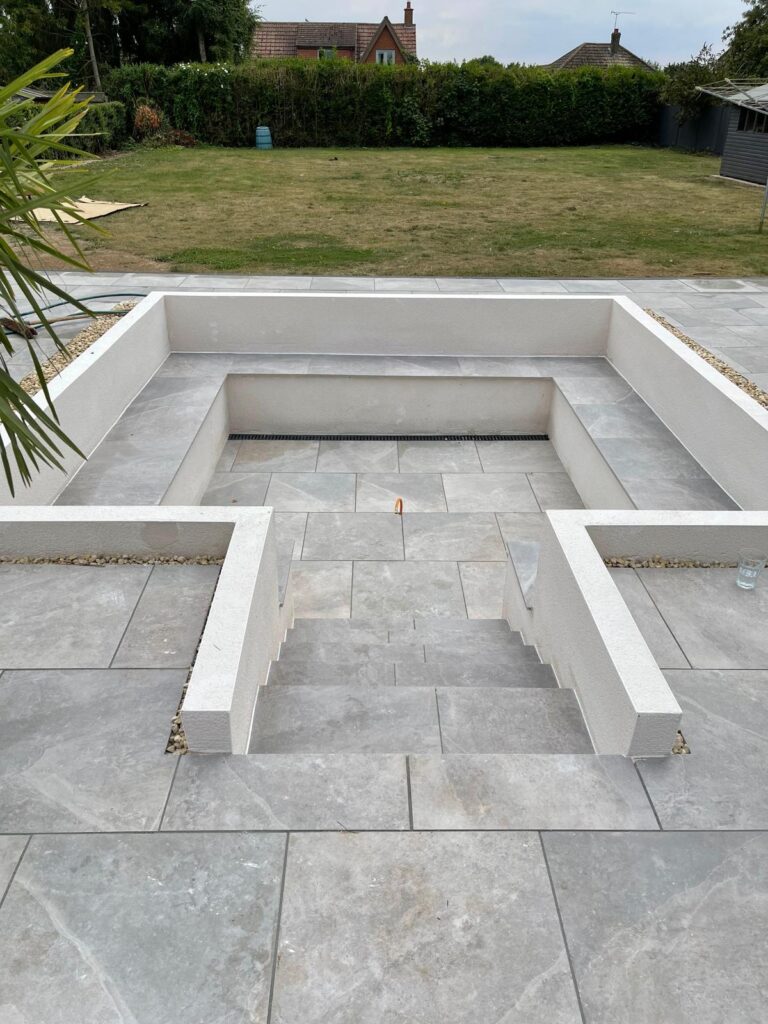
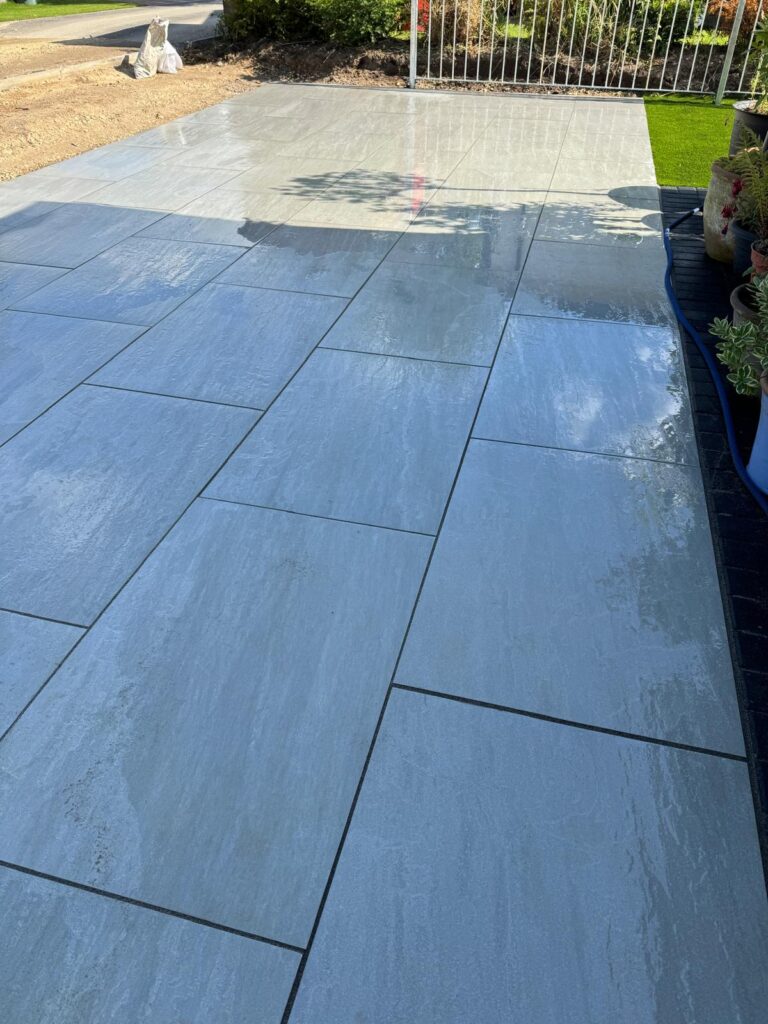
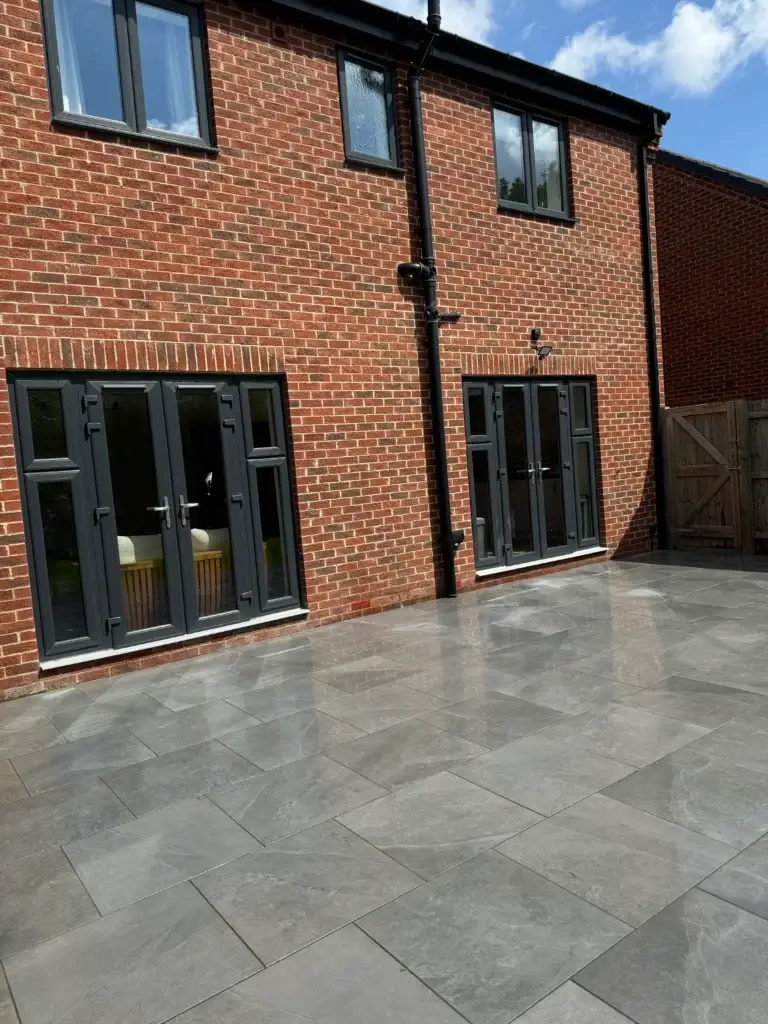
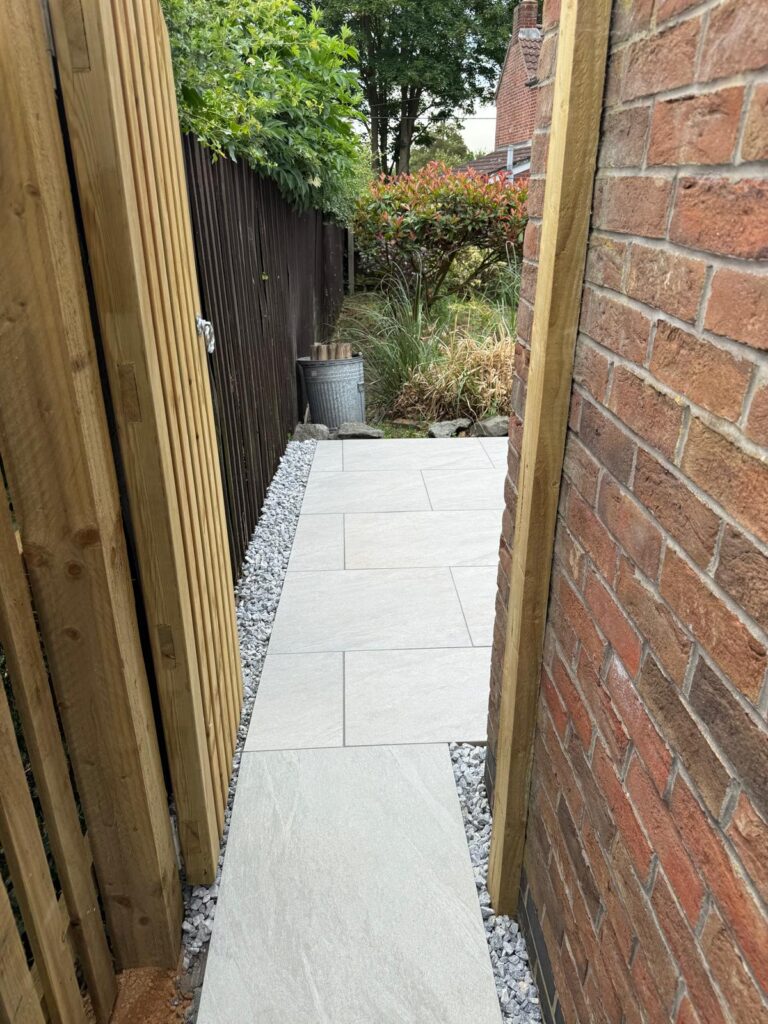
Porcelain Paving in Lincoln and Scunthorpe
We lay porcelain patios, paths and steps in Lincoln, Gainsborough, Scunthorpe and Sleaford, from standard 600mm slabs to large-format pieces. Stone-effect, concrete-effect and wood-effect porcelain are all available, and samples can be brought to the site visit so the colour can be seen against the house.
Porcelain is often carried through to the steps and edging as well, with bullnose steps and mitred corners on the step treads, so one material runs through the garden. Our patios and paving page covers porcelain alongside the sandstone, limestone, granite and Yorkshire stone we lay.
Explore the rest of what we do
What to Ask a Patio Contractor About Porcelain
Before booking a porcelain patio, ask whether every slab will be primed and laid on a full mortar bed. Without the primer, porcelain does not bond to the mortar.
Ask what jointing compound will be used and whether it is made for porcelain.
If a contractor skips any of the stages above, ask what they are leaving out and why.
It is also worth asking to see finished patios. Our recent projects and the patios gallery show completed work from across Lincolnshire.
WHY HOMEOWNERS PICK US
We are a British-owned and run landscaping company based in Lincoln, covering the city, Gainsborough, Scunthorpe, Sleaford and the surrounding areas.
- Established in 2010, with over 400 completed projects.
- Prestige Awards 2026 – Landscaper of the Year, Lincolnshire.
- Houzz 2026 Best of Service award, judged on customer feedback.
- Midlands Enterprise Awards 2026 – Best Bespoke Garden Landscaping Service, Lincolnshire.
- Approved installers for Talasey Landscaping Solutions and Select Living Group.
- Helped design and build a Japanese-inspired garden featured on ITV’s Garden of the Year.
- Insured, including public liability.
Porcelain Paving: Frequently Asked Questions
Can porcelain paving be laid on sand?
No. Porcelain is laid on a full mortar bed over a compacted sub-base, with a slurry primer on the back of each slab. Laid on sand or on spots of mortar, the slabs rock and the joints break up.
Is porcelain better than sandstone?
For low upkeep, usually. Porcelain does not stain or grow moss the way sandstone can, and it keeps its colour. Sandstone has a natural, riven finish that suits older properties and more traditional gardens. We lay both.
Do you lay porcelain paving in Scunthorpe?
Yes. We lay porcelain patios in Scunthorpe, Lincoln, Gainsborough, Sleaford and throughout Lincolnshire.
Does porcelain paving need sealing?
No. Porcelain absorbs so little water that it does not need sealing. Some sealers can change the finish of porcelain, so check with the manufacturer before using one.
Is porcelain paving slippery when wet?
Most outdoor porcelain carries an R11 slip rating, which suits patios, paths and steps. Keeping it clean of algae keeps the grip at its best.
Can porcelain be laid on sand?
No. Porcelain must be primed and laid on a full mortar bed. Laid on sand or spots of mortar, the slabs do not bond and will rock or crack.
Areas We Cover
We lay porcelain paving in Lincoln, Gainsborough, Scunthorpe and Sleaford, and throughout the surrounding areas, including North Hykeham, Waddington, Bracebridge Heath, Branston, Washingborough, Nettleham, Welton, Saxilby, Scotter and Kirton in Lindsey.
Book Your Free Site Visit
We are Lincoln based landscapers and winners of the Prestige Awards 2026 Landscaper of the Year for Lincolnshire. We lay porcelain, sandstone, limestone, granite and Yorkshire stone patios in Lincoln, Gainsborough, Scunthorpe and Sleaford, and throughout Lincolnshire. Our patios and paving page covers each material.
Every project starts with a consultation and a site visit, and we then send a written quote setting out each stage of the work. Fill in the form with your address and a few details of the garden so we can come back to you, or use our contact page to get in touch.
We reply to every enquiry within 48 hours.
Keep reading